Decode Flight Insurance Fast Using an AI Planner Workflow

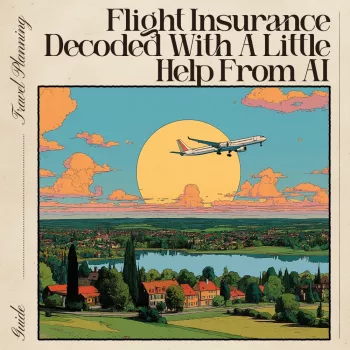
Flight Insurance Decoded with a Little Help from AI: A Practical Travel Planner Guide
Flight insurance can look simple at checkout and feel confusing when plans change. A lightweight AI-assisted approach makes it easier to spot what’s covered, what isn’t, and which policy features matter for a specific trip. This guide breaks down common flight insurance benefits, exclusions, and decision points, then shows how to use an AI travel planner workflow to compare options and document choices clearly.
What Flight Insurance Typically Covers (and What It Usually Doesn’t)
Most flight insurance is built around a handful of predictable problems: you can’t leave, you can’t continue, you’re delayed, you miss a connection, or your bags don’t show up. The tricky part is that coverage often depends on narrow definitions, strict timelines, and documentation rules.
- Trip cancellation: reimbursement when a covered reason prevents departure (examples can include illness, injury, or certain emergencies). Policies list covered reasons—if it’s not listed, it may not count.
- Trip interruption: reimbursement for unused portions plus eligible costs to get home when a covered issue occurs mid-trip. Watch how “unused” is calculated and whether the insurer must approve changes.
- Trip delay: fixed or reimbursed benefits after a minimum delay threshold; often used for meals, lodging, and essentials.
- Missed connection: coverage when a delay causes a missed onward flight, usually with tight timing rules and “common carrier” requirements.
- Baggage delay/loss: limited reimbursement; receipts and reporting timelines matter, and valuables may have strict sub-limits.
- Common exclusions: known events, foreseeable issues, routine changes of mind, and pre-existing conditions without a waiver.
- Important nuance: airline refunds/rebookings and credit card protections can overlap with insurance—double counting is common.
Quick Coverage Map: Benefit, Typical Trigger, and What to Verify
| Benefit | Typical trigger | Verify before buying |
|---|---|---|
| Trip cancellation | Covered reason prevents travel | Covered reasons list; documentation required; pre-existing condition waiver timing |
| Trip interruption | Covered event during trip | Return transportation limits; unused trip cost calculation; who must approve changes |
| Trip delay | Delay beyond minimum hours | Minimum delay threshold; daily cap; eligible expenses; receipts required |
| Missed connection | Late arrival causes missed onward segment | Connection window rules; common carrier requirement; alternative transport coverage |
| Baggage delay | Bag arrives late | Waiting period; per-day limit; essentials definition |
| Baggage loss | Bag permanently lost/damaged | Sub-limits for valuables; depreciation rules; airline claim requirement first |
A Simple AI-Assisted Workflow to Compare Policies Without Getting Overwhelmed
AI is most useful here as a fast organizer—not a decision-maker. The goal is to turn dense policy language into consistent fields you can compare across insurers, then confirm everything against the actual certificate or policy wording.
- Collect trip facts in one place: dates, destinations, carriers, total prepaid costs, connection times, traveler ages, and any medical considerations.
- Paste policy text or benefit summaries into an AI tool and request extraction of: covered reasons, key limits, exclusions, and claim deadlines.
- Ask for a plain-language coverage summary plus a “gotchas list” (missing benefits, narrow triggers, strict timelines).
- Run a scenario check: illness before departure, severe delay, weather disruption, missed connection, baggage delay, and a return-home emergency.
- Generate a side-by-side comparison using the same headings for each policy (limits, deductibles, waiting periods, exclusions).
- Save outputs as a decision log: what was purchased, why, and which clause supported the choice.
Tip: Always verify AI summaries against the actual policy wording. Definitions and endorsements (like CFAR) can change coverage in ways a shortcut summary can miss.
Smart Policy Comparison: The Fields That Change the Outcome
Two policies can look similar at checkout and behave very differently when you file a claim. These are the comparison fields that most often change outcomes.
For consumer-focused background on how travel insurance is regulated and discussed, the National Association of Insurance Commissioners (NAIC) provides a helpful overview. For air-travel disruption rights and airline responsibilities, the U.S. Department of Transportation Aviation Consumer Protection hub is a solid reference point.
Printable Decision Checklist: What to Gather Before You Buy (and Before You Claim)
When Flight Insurance Is Worth It (and When It’s Redundant)
A Guided Tool for Faster Comparison: AI-Friendly Planner + Printable
Recommended tools from our store:
Flight Insurance Decoded with a Little Help from AI | Travel Planner Guide | Using AI to Understand Flight Insurance | Smart Policy Comparison Printable,
Luxury Large Capacity Bowling Shoulder Bag with Sausage Dog Pendant,
2-3 Person Low EMF FAR Infrared Sauna with Tempered Glass and App Control.
FAQ
Is flight insurance the same as travel insurance?
Not always. Flight-focused coverage often emphasizes cancellations, delays, missed connections, and baggage issues, while broader travel insurance may also bundle medical, evacuation, and additional protections. Names vary by seller and insurer, so the benefit list matters more than the label.
What does “Cancel For Any Reason” usually require?
CFAR is typically time-sensitive and may require purchase soon after your first trip payment, plus canceling a minimum amount of time before departure (often 48+ hours). Reimbursement is usually partial and may apply only to certain prepaid trip costs, so the endorsement details are critical.
How can AI help without risking mistakes?
Use AI to extract and organize clauses, standardize fields for comparison, and generate scenario-based checklists, then confirm every key point in the policy certificate/wording. Definitions and exclusions can change the meaning of a benefit, so verification is the safeguard.










Leave a comment