6PCS Kids Balance Stepping Stones for Indoor/Outdoor Play
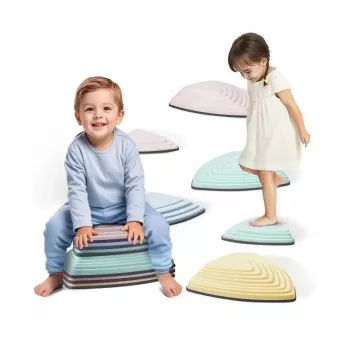
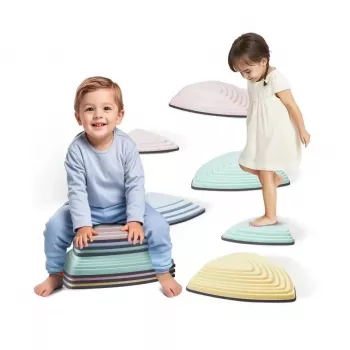
6PCS Children’s Balance Stepping Stones: Active Play for Balance, Coordination, and Confidence
A set of balance stepping stones can turn almost any space into a mini obstacle course—supporting gross motor skills, body awareness, and imaginative movement games. Whether you’re setting up a short indoor route on a rainy day or adding an active station outside, stepping stones give kids a fun reason to practice balance, coordination, and controlled movement. Regular physical activity supports healthy growth and development, and playful movement options make it easier to keep kids engaged day after day (see the CDC’s guidance on physical activity for children).
What balance stepping stones encourage during play
Balance stepping stones are simple, but the skills they build can be surprisingly broad—especially when you vary the spacing, direction, and “rules” of the game.
Balance and postural control
Stepping from one surface to the next encourages children to stabilize through the core, hips, and ankles. Small wobbles become opportunities to practice correcting posture and finding steady footing.
Coordination and motor planning
When stones are arranged in zigzags, curves, or uneven spacing, kids must plan each move, adjust stride length, and control speed. This kind of “think-and-move” challenge is a big part of developing smooth, confident movement.
Proprioception and spatial awareness
Navigating a route helps children understand where their bodies are in space and how much force to use when stepping up, stepping down, turning, or hopping.
Confidence through progressive challenge
One of the biggest wins is how easily the difficulty can scale. Starting with stones close together builds success quickly; widening gaps and adding turns creates a natural next step without changing equipment.
Imaginative play that keeps practice fun
Stones become “lava rocks,” “islands,” “mountain steps,” or “secret agent platforms.” Imagination keeps repetition from feeling like practice—so kids stay active longer.
Quick overview: 6PCS Children’s Balance Stepping Stones
A six-piece set is a sweet spot for everyday use: enough pieces to build a satisfying route, but not so many that setup becomes a chore. It works well for movement games, obstacle courses, and quick “energy breaks” between calmer activities.
- A six-piece set designed for active play, obstacle courses, and balance games.
- Fits short routes in smaller rooms while still offering variety through rearranging patterns.
- Works for solo practice or group games with turns, timed challenges, or call-and-response rules.
At-a-glance features to check before play
| Feature | What to look for | Why it matters for kids |
|---|---|---|
| Stone count | 6 pieces | Enough for short routes and easy rearranging without overwhelming setup |
| Surface grip | Textured top / stable footing | Helps reduce slips during quick steps and jump-down landings |
| Base stability | Non-slip contact points or stable base | Helps stones stay in place on smooth floors during turning and hopping |
| Height variation | A mix of heights or stackable feel (if included) | Adds difficulty options for toddlers through older children |
| Indoor/outdoor use | Materials that wipe clean | Supports flexible play: playroom, patio, or yard |
| Storage | Nestable/stackable shape | Makes cleanup quick and encourages regular use |
Safe setup: where and how to place stepping stones
A good setup reduces bumps and frustration—especially for younger kids who are still learning how to step down with control.
- Choose a clear zone: Move small furniture, remove sharp-edged items, and pick up loose rugs that can bunch underfoot.
- Add a soft boundary: For beginners, use a foam mat or carpeted area indoors, or set up on grass outdoors to soften step-down landings.
- Start low and close: Place stones in a straight line with small gaps so kids can build confidence before trying zigzags or wider spacing.
- Use a “spotter” rule for new skills: For hopping, turning, or one-foot holds, stay within arm’s reach until the child shows steady control.
- Create a one-way route for groups: Kids travel in a single direction, then loop back outside the course to prevent collisions.
Many pediatric health organizations recommend building movement into a child’s day, and obstacle-course play is a practical way to make activity feel like a game (see the NHS activity guidelines for children and young people).
Games and skill builders for different ages
Use the same six stones for very different skill levels by changing only one variable at a time—distance, direction, or speed.
Toddlers (with close supervision)
- “Big step, small step”: Alternate a close stone and a slightly farther stone.
- Freeze on a stone: Pause for 2 seconds, then step to the next.
- Animal walks between stones: Bear crawl or crab walk on the floor, then stand to step onto the next stone.
Preschoolers
School-age kids
Easy progression ideas
Cleaning, storage, and durability habits
Who benefits most from a six-piece set
More in-stock picks
- 6PCS Children’s Balance Stepping Stones
- Luxury Large Capacity Bowling Shoulder Bag with Sausage Dog Pendant
FAQ
What age is appropriate for children’s balance stepping stones?
Many children can enjoy stepping stones from toddler age through elementary years with close supervision for younger kids. Start with stones close together and simple rules, then increase spacing and add turns or timed challenges as balance improves.
Can balance stepping stones be used indoors on hardwood or tile?
Yes, as long as you clear the area, confirm the bases grip well, and keep the bottoms free of dust that could cause sliding. For beginners, placing a foam mat or rug underneath can add traction and soften step-down landings.
How can play be made more challenging as a child improves?
Increase the distance between stones, switch to zigzags, add one-foot holds, and include turns or gentle hops. You can also introduce timed routes, have kids carry a light object, or use simple “memory path” sequences to build control and focus.






Leave a comment